LLC for Consultants: Is It Worth It for Your Business?

By Lisa Matthews, General Manager and Business Compliance Advisor at Next Step Filings.
If you are a consultant wondering whether forming an LLC is worth the effort, the short answer is yes for the vast majority of consulting professionals. An LLC provides personal asset protection, tax flexibility, and professional credibility while being relatively simple and affordable to set up and maintain. Whether you offer management consulting, IT consulting, financial advisory, marketing strategy, or any other type of professional guidance, operating without a formal business structure leaves your personal finances exposed in ways most consultants do not realize until something goes wrong.
This guide walks through everything you need to know about creating an LLC for consulting services, from whether you actually need one and how it compares to other structures, to the step-by-step formation process and the ongoing compliance obligations that keep your business in good standing. Next Step Filings helps consultants form, maintain, and stay compliant with their LLCs so they can focus on serving clients instead of chasing paperwork.
Does a Consultant Need an LLC
No, a consultant is not legally required to form an LLC to operate a consulting business. You can work as a sole proprietor from day one without filing any paperwork. But just because you can operate without one does not mean you should. Most consultants benefit significantly from the liability protection, tax advantages, and professional credibility that an LLC provides.
The risk of operating without an LLC is straightforward: there is no legal separation between you and your business. If a client sues you because your advice led to a financial loss, or if your business takes on debt it cannot repay, creditors can go after your personal bank accounts, your home, your car, and your retirement savings. For consultants, this risk is not hypothetical. Consulting is an advice-driven profession, and the advice you give can directly impact your clients' bottom lines.
IT consultants face exposure when system recommendations fail or data breaches occur. Management consultants carry risk when strategic advice leads to poor outcomes. Financial consultants operate in an environment where errors and omissions can result in six-figure lawsuits. Freelance consultants working with multiple clients multiply their exposure points with every new engagement.
An LLC is especially valuable when:
If any of these apply to you, forming a consulting LLC is not just worth considering. It is one of the most important business decisions you can make.
What Is a Consulting LLC
A Limited Liability Company, or LLC, is a business structure recognized by every state that creates a legal separation between your personal finances and your business operations. When you hear the term "consulting LLC," it simply means an LLC that has been formed for the purpose of operating a consulting practice.
There is no special category of LLC for consultants. You file the same formation documents as any other LLC. The "consulting" part describes what your business does, not how it is structured. Once formed, your consulting LLC exists as its own legal entity. It can open bank accounts, enter into contracts with clients, and own assets independently of you as an individual.
This legal separation is the core of what makes an LLC valuable for consultants. Without it, you and your consulting practice are legally the same person, meaning your personal wealth is fully exposed to any business liabilities that arise from your professional work.
Benefits of Forming an LLC for Your Consulting Business
An LLC offers consultants specific advantages over operating as a sole proprietor. These benefits go beyond paperwork and directly affect your financial security, your tax situation, and your ability to win clients. Next Step Filings helps consultants understand these benefits and guides them through the formation process so nothing gets overlooked.
Personal asset protection
This is the single most important reason for a consultant to form an LLC. The limited liability structure means that your personal assets, including your house, car, savings accounts, and retirement funds, are generally shielded from lawsuits and debts connected to your consulting business.
"Limited liability" means exactly what it sounds like: your liability is limited to what you have invested in the business. If a client sues your consulting LLC because your strategic recommendations did not deliver the expected results, or because a data migration you oversaw caused downtime that cost them revenue, only the assets inside your LLC are typically at risk. Your personal finances stay protected.
For consultants, this matters more than it does for many other business types. Consulting is fundamentally about giving advice, and advice can go wrong. A retail store owner faces product liability risk. A consultant faces intellectual liability risk, which is harder to predict and control. Errors and omissions exposure is baked into the consulting profession, and an LLC provides the first layer of defense against it.
Pass-through taxation and tax flexibility
By default, an LLC is a "pass-through" entity for tax purposes. This means your consulting income flows directly through to your personal tax return. The LLC itself does not pay federal income tax. You avoid the double taxation that C corporations face, where the company pays corporate tax and then shareholders pay personal income tax on dividends.
What makes the LLC structure particularly flexible for consultants is the ability to elect different tax treatments as your business grows. You can start with default pass-through taxation when your income is modest, and later elect S-corp tax treatment if your profits reach a level where the payroll tax savings justify the added complexity. This flexibility means you do not have to choose the perfect structure from day one.
Professional credibility with clients
Adding "LLC" to your consulting business name signals that you have taken the steps to formalize your practice. This matters more than many consultants realize. Potential clients, especially corporate procurement departments, evaluate vendors based partly on business structure. A registered LLC communicates stability, professionalism, and accountability.
Some corporate clients flatly require vendors to be registered business entities before they will sign a contract. If you are competing for a consulting engagement against someone who has an LLC and you are operating as a sole proprietor, you may lose the deal before your qualifications are even considered. The credibility of a formal business structure can be the difference between landing a contract and being passed over.
Simplified compliance compared to corporations
If liability protection and tax flexibility are your goals, you could also form a corporation. But corporations come with significantly more administrative burden. They require a board of directors, formal shareholder meetings, corporate minutes, and strict recordkeeping protocols.
An LLC gives you similar legal protection with far fewer formalities. There are no required board meetings, no shareholder resolutions to document, and no complex corporate governance rules to follow. You still have ongoing compliance obligations like annual reports and maintaining good standing with the state, but these are manageable, especially with a service like Next Step Filings tracking your deadlines.
Drawbacks of a Consulting LLC
No business structure is perfect, and being honest about the drawbacks helps you make an informed decision. Here is what you should weigh against the benefits.
Formation and annual maintenance costs
Unlike a sole proprietorship, which costs nothing to start, forming an LLC requires paying state filing fees. These vary by state, ranging from around $50 to over $500 for the initial formation. On top of that, most states charge annual or biennial renewal fees to keep your LLC in good standing. Some states also impose franchise taxes or business privilege taxes regardless of your income level.
For most consultants earning steady income, these costs are modest relative to the protection they provide. But if you are just starting out and testing whether consulting is viable, you should factor these expenses into your budget.
Self-employment tax obligations
As the owner of a consulting LLC taxed under the default structure, you pay self-employment tax on all of your business income. Self-employment tax covers Social Security and Medicare contributions and currently runs about 15.3 percent on your net earnings. This applies to your full business profit, not just what you pay yourself.
This is one of the reasons some consultants eventually elect S-corp tax treatment, which can reduce the self-employment tax burden by allowing you to split income between salary and distributions. More on that in the tax section below.
State-specific filing requirements
Every state has its own rules, deadlines, and fees for LLC formation and maintenance. What works in Texas does not necessarily apply in California or New York. Some states require publication of your LLC formation in local newspapers. Others have minimum franchise taxes that apply even if your business earns nothing.
Missing a state deadline can result in late fees, penalties, or even administrative dissolution of your LLC. This is where consultants who handle their own compliance often run into trouble. They form the LLC successfully but then miss an annual report deadline two years later because no one reminded them it was due.
LLC or Sole Proprietorship for Consulting
This is one of the most common questions consultants ask, and the answer for most is clear: an LLC is the better choice if you are serious about your consulting practice. A sole proprietorship is the default when you start working for yourself without filing any business formation documents. It is the simplest and cheapest way to operate, but it offers zero personal liability protection.
Here is a direct comparison to help you decide:
FactorSole ProprietorshipConsulting LLCPersonal liability protectionNoneYesFormation requirementsNoneState filing requiredOngoing complianceMinimalAnnual renewals requiredTax treatmentPass-throughPass-through (default)Professional credibilityLowerHigherSetup costFreeState fees applyE&O liability exposureFully personalLimited to business assetsAbility to elect S-corp statusNoYes
If your consulting work is a side project generating a small amount of income and involving minimal client risk, a sole proprietorship may be adequate temporarily. But the moment you are earning meaningful income, signing client contracts, or giving advice that could result in financial consequences for others, the lack of liability protection in a sole proprietorship becomes a serious vulnerability. For most consultants who are building a real practice, setting up an LLC for consulting is one of the first steps they should take.
Should You Choose an LLC or S-Corp for Your Consulting Business
This is another question that comes up frequently, and it is important to clarify a common misconception first. An S-corp is not a business structure. It is a tax election. You do not choose between forming an LLC and forming an S-corp. Instead, you form an LLC and then optionally elect to have it taxed as an S-corp.
Under the default LLC tax treatment, all of your consulting income is subject to self-employment tax. When you elect S-corp status, you pay yourself a reasonable salary (which is subject to payroll taxes), and any remaining profit can be distributed to you without self-employment tax. This can result in meaningful tax savings once your consulting income reaches a certain level.
S-corp election may make sense for your consulting business LLC when: If you are just starting a consulting LLC, the default pass-through taxation is usually the right starting point. You can always elect S-corp status later as your income grows. The flexibility to make this change without restructuring your entire business is one of the LLC's biggest advantages.
How to Start a Consulting Business LLC
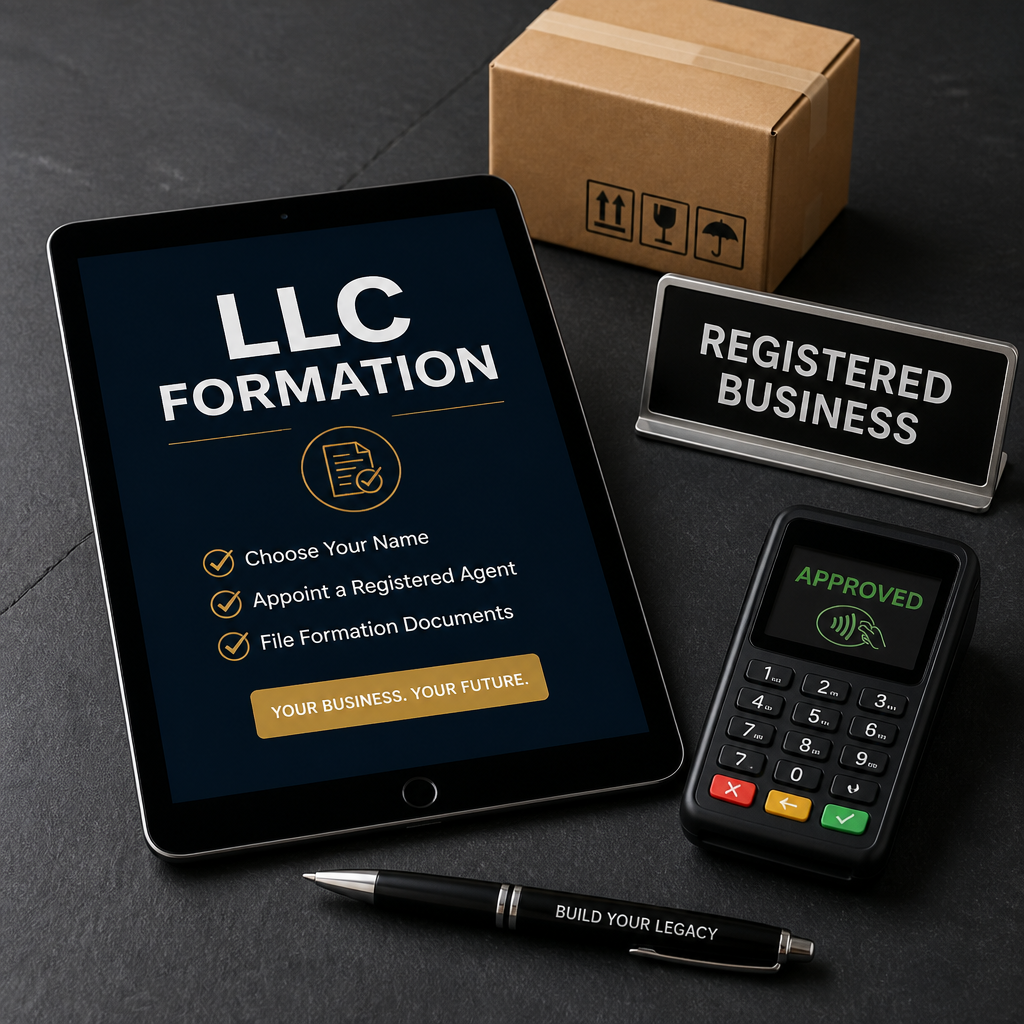
The formation process for a consulting LLC follows the same steps as any other LLC. It is straightforward, but each step matters. Next Step Filings handles this entire process for consultants who prefer a done-for-you approach, but here is what the process involves whether you do it yourself or use a service.
1. Choose a compliant name for your consulting LLC
Your LLC name must meet your state's naming requirements. In every state, the name must include "LLC," "L.L.C.," or "Limited Liability Company." It cannot be the same as or deceptively similar to an existing business name registered in your state.
Before settling on a name, search your state's business name database to confirm availability. Many consultants use their own name followed by "Consulting LLC" or choose a brand name that reflects their specialty. Whatever you choose, make sure it is available not just with the state but also as a domain name if you plan to build a website.
2. Select a registered agent
Every LLC is required to designate a registered agent in the state where it is formed. A registered agent is a person or service authorized to receive legal documents, government correspondence, and official notices on behalf of your business. This includes lawsuit notifications, tax notices, and compliance reminders.
You can serve as your own registered agent in most states, but that requires you to be available at a physical address during business hours. Many consultants use a registered agent service instead, which ensures documents are received promptly even when you are traveling or meeting with clients. Next Step Filings offers registered agent services as part of their consulting LLC support.
3. File your articles of organization
The articles of organization, sometimes called a certificate of formation depending on your state, is the official document that creates your LLC. You file it with your state's Secretary of State or equivalent business filing office. The document typically includes your LLC's name, its principal address, the registered agent's name and address, and the names of the members or organizers.
Filing fees vary by state. Processing times also differ. Some states offer expedited processing for an additional fee if you need your LLC active quickly to start signing client contracts.
4. Obtain an EIN from the IRS
An Employer Identification Number, or EIN, is your LLC's tax identification number. Think of it as a Social Security number for your business. You need an EIN to file taxes for your consulting LLC, open a business bank account, and hire employees or independent contractors.
Applying for an EIN is free and can be done directly through the IRS website. The process takes only a few minutes online, and you receive your number immediately. There is no reason to pay a third party for this specific step, although formation services like Next Step Filings typically include it as part of a comprehensive package.
5. Draft an operating agreement
An operating agreement is an internal document that outlines how your consulting LLC is owned, managed, and operated. Not every state legally requires one, but having an operating agreement is strongly recommended even for single-member consulting LLCs.
Why does it matter if you are the only owner? Because an operating agreement establishes your LLC as a separately managed entity, which strengthens the legal separation between you and your business. If your liability protection is ever challenged in court, having a documented operating agreement is one of the factors judges consider when deciding whether the "corporate veil" holds. It also establishes clear rules for what happens if you bring on a partner, sell the business, or need to dissolve it.
6. Open a business bank account
Once you have your EIN and formation documents, open a dedicated business bank account for your consulting LLC. This is not optional in a practical sense. Commingling personal and business funds is one of the fastest ways to undermine the liability protection your LLC provides.
A separate business bank account creates a clear paper trail that distinguishes your personal transactions from your consulting revenue and business expenses. You will need your EIN, your articles of organization, and your operating agreement when you visit the bank. Every dollar your consulting business earns should flow through this account, and every business expense should be paid from it.
Best State to Form an LLC for Consulting
You may have heard that Delaware, Wyoming, or Nevada are the best states to form an LLC because of their business-friendly laws or tax advantages. While these states do have certain benefits, they are generally not the best choice for consultants who live and work in a single state.
Here is why: if you form your LLC in Delaware but you live and operate your consulting business in Texas, you will need to register your Delaware LLC as a foreign LLC in Texas. That means you are paying formation and annual fees in Delaware plus registration and annual fees in Texas. You are doubling your costs and compliance obligations for benefits that rarely apply to small consulting practices.
For most consultants, the best state to form an LLC for consulting is the state where you live and conduct business. This keeps your costs lower, your compliance simpler, and your legal standing straightforward. The exception is if you have a specific legal or tax reason to form elsewhere, which is something a business attorney or tax professional can help you evaluate.
How a Consulting LLC Is Taxed
Tax treatment is one of the biggest factors in deciding to form a consulting LLC, and the good news is that the LLC structure gives you options. Here is how it works at each level.
Default tax classification for single-member and multi-member LLCs
A single-member consulting LLC is treated as a "disregarded entity" by the IRS. This means the LLC itself does not file a separate federal income tax return. Instead, all business income and expenses are reported on your personal return, typically on Schedule C of Form 1040. You pay income tax on your net profit at your individual tax rate.
If your consulting LLC has two or more members, the IRS treats it as a partnership by default. The LLC files an informational return (Form 1065), and each member receives a Schedule K-1 showing their share of the income, deductions, and credits. Each member then reports their share on their personal return.
In both cases, the LLC itself does not pay federal income tax. The income "passes through" to the individual owners, which is why this is called pass-through taxation.
Electing S-corp tax status
If your consulting income reaches a level where self-employment tax becomes a significant expense, you can elect to have your LLC taxed as an S-corp by filing Form 2553 with the IRS. This election does not change your business structure. Your LLC still exists. It only changes how the IRS taxes it.
Under S-corp taxation, you pay yourself a reasonable salary for the work you do. This salary is subject to payroll taxes, including Social Security and Medicare. Any profit above your salary can be distributed to you as an owner distribution, which is not subject to self-employment tax. If your consulting LLC earns $150,000 and you pay yourself a $80,000 salary, the remaining $70,000 in distributions avoids the 15.3 percent self-employment tax, potentially saving you over $10,000.
The trade-off is added complexity. You must run payroll, file quarterly payroll tax returns, and ensure your salary meets the IRS's "reasonable compensation" standard for your role and industry. The S-corp election makes the most sense for established consulting practices with consistent profits above $50,000 to $60,000 annually.
Self-employment taxes and deductions
Under the default LLC tax structure, you pay self-employment tax of 15.3 percent on your net business income (12.4 percent for Social Security, up to the annual wage base, and 2.9 percent for Medicare with no cap). This is in addition to your regular income tax.
The good news is that consulting LLCs have access to a wide range of business deductions that reduce your taxable income. Common deductions for consultants include:
Tracking these deductions carefully throughout the year can significantly reduce your tax burden. Working with a tax professional who understands consulting businesses is strongly recommended.
What to Do After You Form Your Consulting LLC
Formation is just step one. What happens after you file your articles of organization is just as important as the filing itself. This is where many consultants drop the ball, and it is where the ongoing value of a compliance service becomes clear.
Understand your annual report requirements
Most states require LLCs to file annual or biennial reports to confirm that the business's information is current and accurate. These reports typically include your LLC's name, principal address, registered agent information, and member or manager names. Each report comes with a filing fee that varies by state.
The deadlines for these reports are set by the state and do not change based on when you formed your LLC. Missing a deadline does not just result in a late fee. In many states, it starts a clock toward administrative dissolution, which means the state can revoke your LLC's legal status entirely.
Maintain good standing with the state
"Good standing" means your LLC is current on all required filings and fees with the state. This status matters more than most consultants realize. Banks may check your good standing status before approving a business loan. Clients may verify it before signing a contract. And in some states, an LLC that falls out of good standing cannot enforce contracts in court.
Next Step Filings tracks your state deadlines, sends reminder notifications before filings are due, and handles the actual submissions so your consulting LLC stays in good standing without you having to manage a compliance calendar yourself.
What happens if you miss a compliance deadline
The consequences of missing a compliance deadline are real and escalate quickly:
These consequences are entirely preventable with proper tracking and timely filings. This is why ongoing compliance support is not an afterthought. It is a core part of maintaining the protection you formed your LLC to get in the first place.
Common Mistakes When Setting Up an LLC for Consulting
Even experienced professionals make avoidable errors when forming and running a consulting LLC. Here are the most common mistakes and how to avoid them:
How Next Step Filings Helps Consultants Form and Maintain Their LLC
Starting a consulting LLC is only the beginning. The real challenge is keeping it compliant year after year while you focus on what you do best: consulting. Next Step Filings takes a compliance-first approach that goes well beyond initial formation.
Here is what Next Step Filings provides for consultants:
What sets Next Step Filings apart is human oversight combined with proactive compliance tracking. Formation is step one. Staying in good standing is the ongoing work that protects your consulting business, your client relationships, and your personal assets for the long term.
Contact Next Step Filings today to form your consulting LLC and keep your business in good standing.
Frequently Asked Questions About LLCs for Consultants
Can a consultant form an LLC while working a full-time job?
Yes, in most cases you can form an LLC while employed full-time. Review your employment contract for non-compete or moonlighting clauses that might restrict outside business activities before proceeding.
How much does it cost to start a consulting LLC?
Costs vary by state but typically include state filing fees for formation (ranging from $50 to $500) and ongoing annual renewal fees. Some states have additional requirements like publication notices or franchise taxes that add to the total cost.
Does forming an LLC replace the need for business insurance?
No. An LLC protects your personal assets from business liabilities, but professional liability insurance, also known as errors and omissions (E&O) coverage, provides additional protection for consulting-specific risks like client claims that your advice caused financial harm.
Can a sole proprietor convert to a consulting LLC?
Yes. You will need to file articles of organization with your state, obtain a new EIN from the IRS, and update your business bank accounts, client contracts, and any licenses or permits to reflect the new entity.
What happens to a consulting LLC if the owner stops working?
The LLC continues to exist as a legal entity and incurs ongoing filing obligations until it is formally dissolved with the state. Next Step Filings offers LLC dissolution services to properly close an inactive entity and end the ongoing state fees and compliance requirements.
Does a consultant need a separate LLC for each client?
No. Most consultants operate all client work under a single LLC. Forming separate LLCs for individual clients is unnecessary unless there is a specific legal or liability reason to isolate certain activities, which is uncommon for typical consulting practices.
How does multi-state consulting work with one LLC?
If you regularly conduct consulting business in a state other than where your LLC is formed, you may need to register as a foreign LLC in that state. This involves additional filing fees and compliance requirements. Next Step Filings can help coordinate multi-state registered agent services and compliance filings to keep you covered wherever you operate.
Disclaimer: Next Step Filings is a private business services company. The information in this article is for general educational purposes only and does not constitute legal, tax, or financial advice. Consult a licensed attorney or tax professional for guidance specific to your situati
Subscribe to the NextStepFillings Updates

Ready to Get Compliance Off Your Mind?
You do not have to manage filings, notices, and penalties alone. We take on the compliance work so your business stays active, protected, and ready for its next step.